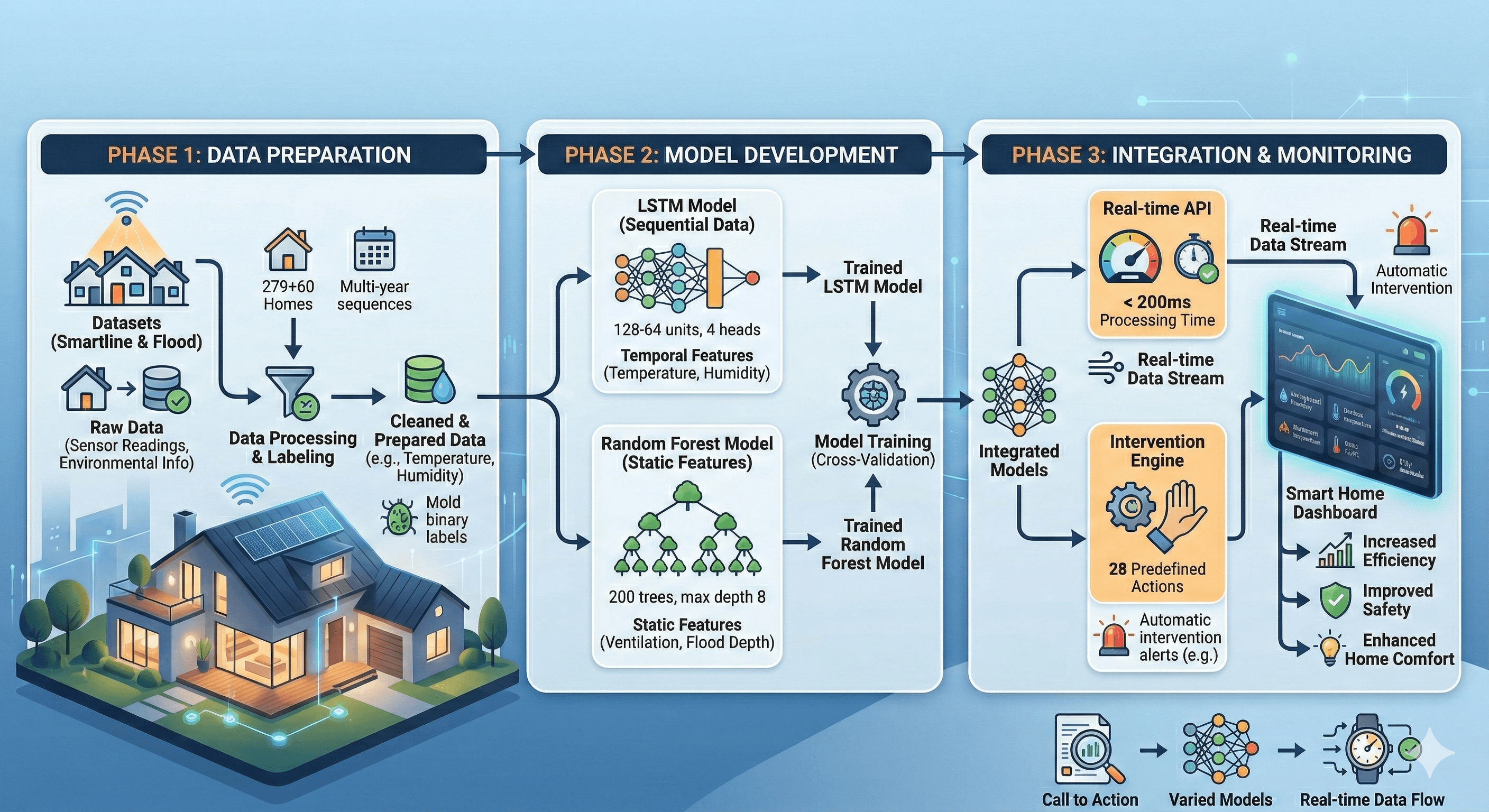
This article explains the home monitoring workflow shown in the diagram, from dataset preparation through model deployment. It focuses on how each stage feeds the next and where real-time decisions happen.
Diagram
Overview
Home monitoring systems collect plenty of signals, but collecting data is the easy part. The difficult part is turning that data into timely, reliable actions. This workflow does that by separating preparation, model training, and production integration.
The first phase builds clean training data. The second phase trains two model types for different signal patterns. The final phase connects predictions to an intervention engine, scheduler, and API so actions can be triggered quickly.
Diagram Breakdown
The workflow is split into three phases.
1. Phase 1: Data preparation
This phase organizes the training inputs:
- Smartline dataset: 279 homes (2017-2023), 355,000 sequences.
- Flood dataset: 60 homes, with spore counts converted to binary mold labels.
If these datasets are noisy or mismatched, downstream model quality drops quickly.
2. Phase 2: Model development
Two models are trained for complementary tasks:
-
LSTM model handles temporal behavior with:
- 128 to 64 units
- 4 output heads
- GroupKFold cross-validation for training
- Huber loss for optimization
- 7 temporal features (for example temperature and humidity)
-
Random Forest model handles static home attributes:
- 200 trees, max depth 8
- 18 static features (including ventilation, flood depth, roof age)
- Stratified 5-fold cross-validation
Using both helps capture short-term signal shifts and longer-term structural risk factors.
3. Phase 3: Integration
Predictions are wired into operational components:
- Intervention engine with 28 predefined actions.
- Daily scheduler for recurring monitoring tasks.
- Real-time API with sub-200ms target latency.
This is where model output turns into concrete actions in production.
Key insights
- Mixed data types usually need mixed models. A single model often misses either temporal nuance or static context.
- Validation strategy matters as much as architecture. Grouped splits can reveal leakage that random splits hide.
- Low-latency serving is part of model quality in monitoring systems. Slow predictions reduce the chance of useful intervention.
Next steps
- Add drift checks for both temporal and static features before scoring.
- Log intervention outcomes so the action policy can be tuned with real feedback.
- Define fallback behavior when API latency or model confidence crosses safe limits.